Zaylan: Where is home to you?
Larissa: Home for me is Charleston, SC. It’s where I’ve lived the longest, consistently my entire life.
Zaylan: And where did you grow up?
Larissa: I was a bit of a military brat, so moved around a good bit. My parents are in Illinois now, so I go there for Christmas and holidays — that’s where I’m heading this week actually.
Zaylan: What’s your favourite hotel that you’ve visited?
Larissa: I’m not sure off the top of my head. It’s funny—on the design side, we usually see hotels when they’re a little more tired and in need of a refresh. The F&B team sees the shiny, brand-new designs, but we’re there before that transformation happens, so it’s a little harder to pick a favorite just seeing the potential versus the final product. Plus, where I’m located, there’s not a lot of new modern-design construction—unlike Dallas or LA where other members of the team are located. Charleston is a very history-rich city so the “new” designs here often reflect that just based on the architecture we have.
Zaylan: No problem. Isn’t Charleston on the come-up, though? I feel like a lot of people are moving there.
Larissa: Oh, definitely! It’s blowing up residentially and has changed so much in the last ten years or so I’ve been here. Commercial growth is trying to follow, but it’s moving a bit slower. After COVID, there was a big influx of people from the North—New York especially—moving down here. That really drove up housing demands so infrastructure is a bit behind.
Zaylan: Gotcha.
Larissa: Yeah, it’s been a crazy time around here.
Zaylan: What about a favourite place you’ve travelled to?
Larissa: For a project, Aruba was probably my favourite. Actually, just in general too. The Aruba trip was a really fun one. We’ve had a number of projects in Arizona so I’ve spent a good amount of time there over the last couple years also.
Zaylan: What about a bucket list destination? Either a hotel you want to visit or a place you want to travel to?
Larissa: I’d really like to get to Europe eventually. Christy and I have been trying to figure out a way to get to the Milan show—that’s our next design goal. Would love some more CALA projects also; summer’s my favourite time of year so any chance to get to the beach is okay by me!
Zaylan: The Milan show?
Larissa: Yeah, there’s a big design show over there and everything they show is just so beautiful and unique. I don’t know if you knew, but we usually try to get the entire design team to the BDNY show in New York—that’s the big U.S. design show. The Milan design show is like BDNY but features so many more brands and manufacturers we typically don’t get to see here in the states.
Zaylan: Wow.
Larissa: Yeah, it’d be amazing to get over there. Plus, European design is just… so much prettier; there’s so much more detail and customization.
“It helps that I learned how to read and draw construction documents in school. That’s something I’ve noticed a lot of younger designers struggle with.”
Zaylan: Are you much of a reader?
Larissa: I’d like to be, but unfortunately I just don’t really have the time anymore.
Zaylan: Do you ever listen to audiobooks or podcasts while you work?
Larissa: I usually just listen to music while I’m working. If I put on a book or podcast, I get too distracted; I’ll start paying attention to what they’re saying and lose focus on my work. Music or something like a reality show works better—something I can just drown out in the background.
Zaylan: What’s your go-to reality show?
Larissa: I’ll usually throw on re-runs of something like The Office or Parks and Rec. If it’s a reality show, then something like Below Deck or anything on Bravo.
Zaylan: Oh my—my sisters are obsessed with that show. It has the most drama.
Larissa: Right? It’s wild, but it’s easy to watch. If you miss two or three episodes and then sit down for lunch or something, you can just pop back in for a 15- or 20-minute break. Watch a little, get back to work, and not feel bad for missing anything.
Zaylan: What about a go-to drink or food item when you’re visiting a new restaurant?
Larissa: For drinks, I’m definitely a vodka-based cocktail person. I don’t do mezcal—I just can’t with that smoky flavor, so I often avoid those. But I don’t really have a go-to drink or dish. Honestly, I don’t have favorites of anything. I like trying new things, and my preferences are always changing—it’s the ADHD in me.
So those “What’s your favourite…?” questions are always hard for me. Like, I don’t even have a favorite color! But I do tend to gravitate toward certain ingredients—vodka-based drinks, for example. Alternately I can definitely tell you what I don’t like —coffee and cheese. Otherwise, I’m pretty open.
Zaylan: Gotcha, that makes sense. Getting into a design question—do you have a designer, artist, or architect whose work you really admire or draw inspiration from?
Larissa: It’s a classic answer, but I’ve always liked Frank Lloyd Wright. His work is so timeless—such a classic design but also really modern, especially for his era. He was so creative and ahead of his time. I admire how he pushed the limits of design and always tried to move things forward.
Zaylan: Love that. And last one from me before I pass it over to Gaby—what does hospitality mean to you?
Larissa: Hospitality, to me, means doing your best to cater to guests and make the client happy.
Gaby: Okay, we're going to dive into your background and early career. You’re one of the only designers we’ve come across with a minor in construction management. What inspired you to pursue that unique combination—interior environmental design with a construction management minor?
Larissa: Honest answer: it only added like two extra credits to my major, so it was an easy decision. But I also knew it would help sell myself down the line. Having that construction background is huge because design and construction go hand in hand. It’s important to understand how things are built to know whether a design is even feasible; helps set you apart as a designer from the decorators who we’re often confused for.
Gaby: That makes a lot of sense. How has that construction knowledge influenced your approach, especially with large-scale hospitality projects?
Larissa: Yeah, similar to what I just said—just understanding how materials work together, how things are built, and what makes something structurally sound. It helps to know if a design idea can actually work in the real world.
Gaby: Do other designers come to you for that perspective?
Larissa: Some of the junior designers might. Christine has about as much experience as I do, and Christy’s the same—they’ve both learned it over time. Honestly, you gain a lot of that knowledge through years of trial and error. But yeah, it helps that I learned how to read and draw construction documents in school. That’s something I’ve seen a lot of younger designers seem to struggle with.
Gaby: Got it. So, sustainability has been a focus in your academic background. Can you share a project or idea from that time that helped shape your views on green design?
Larissa: Sustainable design was a small focus of my educational background beings that where I went to school focused more on commercial design; I had certain classes that it was the primary focus, but was also part of the LEED organization on campus. Sustainability is always shaping the way design and construction morph through materiality and building practices, so it’s definitely important to consider and keep in mind through a project. Every part of the design world is pushing for more sustainable options, whether it's recycled fabrics, low-toxicity materials, or reusing resources in creative ways. It’s just becoming a standard that we all need to pay attention to.
Gaby: Looking back at your early career, is there a project or experience that had a big impact on shaping who you are today?
Larissa: In terms of hospitality design, yes, I’d say the Westin Hilton Head project. It was the first large-scale project I worked on with EAG and was a guestroom renovation at that. It really was a great bridge from my prior residential background into the hospitality world.
“Everything is constantly evolving—materials, technology, brand standards—they’re always changing.”
Zaylan: What’s your favourite part of the design process—from concept to completion?
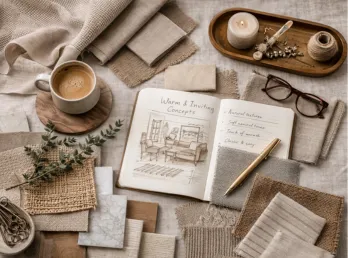
Larissa: My favourite part is definitely concept design. I love pulling those initial detail images and finishes together; mixing styles to create something new and innovative, but still classic.
Zaylan: Let’s shift into some storytelling and sustainability-related questions. Chris always emphasizes how important storytelling is to hospitality. How do you find yourself incorporating a project’s story into the design?
Larissa: Yeah, storytelling is definitely a huge part of hospitality design and design in general. Creating a design that tells that story is what helps people connect and understand the design of a space.
We start with a lot of market research—looking at the location and the history of the area. Often we’ll try to find something unique about the city, the region, or even the state to help shape that story, then expand from there. Finishes, furniture, lighting, art – it all helps shape and tell that story to the end user.
Zaylan: Interesting—so the furniture itself can help evoke those story elements?
Larissa: Exactly. For example, Christy designed the amenities cabinet for a renovation in Tucson, Arizona. Part of our narrative involved old saloon wagons from back in the day because that area has a lot of rich history from the gold rush. The shape of the cabinet resembles an upside-down saloon wagon, with a barrel form at the base. It’s not something you’d immediately look at and say, “Oh, that’s a saloon wagon,” but it’s a subtle nod. Sometimes it’s more literal, sometimes it’s just loosely inspired by the story.
Zaylan: Very cool. And that “environmental design” degree—does that mean landscape design? What does it actually mean to be an environmental designer?
Larissa: Yeah, that’s my major was in Interior and Environmental Design. I believe they named it that way because green design elements were incorporated into the curriculum; understanding the effects construction and design have on the environment was a portion of what I studied in school. When I was in school, sustainability wasn’t as big of a focus yet as it is today, but the industry is ever evolving. Green design is something that continues to grow and requires ongoing education in the industry.
Zaylan: And green design—that basically just means sustainable design, right?
Larissa: Yep, correct.
Zaylan: Gotcha. So what role does sustainability play in your design philosophy? And how do you balance that with other demands, like aesthetics and functionality? How do you actually incorporate the sustainability piece?
Larissa: A lot of the fabrics we choose now are PFAS-free—so, we’re moving away from materials with harsh chemicals while still making sure they’re durable. There are also wallcoverings and applied trims made with recycled materials. Certain stones (like quartz) have gone through bans and restrictions that affect materials we are able to source -- It also depends on the location; some areas, like California for example, have much stricter green codes. One project we’re working on is trying to eliminate the use of natural gases, so finding alternate sources for outdoor fireplaces or heaters are even some challenges we run into.
Additionally, if a project is trying to become LEED-certified, then we definitely have more restrictions and requirements to follow when it comes to material selections and building processes. It really varies project to project, though. Some projects allow more flexibility, while others require us to be super intentional—making sure every material meets sustainable standards.
Zaylan: Do you remember any projects where sustainability and storytelling came together?
Larissa: The Westin Kierland comes to mind. I believe they were trying to go for LEED certification to start; I’m not sure if they actually followed through with all of the protocols that are required for approvals, but we did make sure to be mindful of our selections and had a good amount of finishes that utilized recycled materials on the project.
Zaylan: What does LEED stand for?
Larissa: Leadership in Energy and Environmental Design.
Zaylan: Ah, okay. I think I’ve seen that on buildings—like a plaque or something that says LEED-certified.
Larissa: Yep, that’s it. If a building meets certain sustainable criteria, it can be LEED-certified. A third party will come in and evaluates it similar to any other trade having their inspections done. There are different certification levels that can be met too — certified, silver, gold, and platinum.
Zaylan: Do you see any major challenges in making hospitality design sustainable? I know Christy mentioned that in hospitality, design elements are getting replaced every seven years or so.
Larissa: Yeah, that’s definitely one of the biggest challenges. Everything is constantly evolving—materials, technology, brand standards—they’re always changing. Like I mentioned before there are materials that go through bans or restrictions as we learn the effects over time. Renovations will take place every few years based on that particular brand’s standards, but green building standards get stricter each year. There are just a lot of moving parts to keep up with.
“We’ve sometimes had 20 people on a call... ownership, architects, contractors—even another design team.”
Gaby: All right, so we’re going to talk a little about Ellis Adams Group. What brought you to EAG, and how has being part of the team influenced your approach to design?
Larissa: I transitioned into hospitality from high-end residential, but have also worked in commercial/educational design also. I actually found Ellis Adams Group on LinkedIn, though. I had gotten really burned out on residential and just needed a change, but knew I wasn’t done with design. I’ve always had a strong passion for it, just needed to find a new approach and perspective to recharge myself.
I started at EAG in 2022, so I’ve been able to witness a lot of the growth we’ve experienced on the design front. I was a little concerned about the learning curve from residential to hospitality when I initially started, but honestly it hasn’t been all that different. I did a lot of custom work before, so for me, the biggest difference is just having to follow a lot more codes since it’s more commercial, like meeting ADA needs.
Gaby: And what values or aspects of EAG’s approach resonate most with you? How do they align with your design philosophy?
Larissa: I really appreciate how much the team cares about each other and how helpful everyone is; I’ve never worked for a company like that before. Previous offices (and residential design in general) feels a lot more cutthroat—every person is just out for themselves and trying to get ahead of one another. But here, people actually lift each other up. That’s been really refreshing.
Gaby: Love that. Is there a particular project at EAG that pushed you to think differently or taught you something new?
Larissa: Each project is different. Every client has their own style, their own way of working. So it’s less about any one project and more about learning to adapt to each client. You have to figure out how they work, what they want, and let that guide your design decisions. That’s what really shifts my approach from one project to the next. As much as creativity is important to a great design, what really matters is customer service.
Gaby: And compared to your residential work, are the timelines longer on these hospitality projects?
Larissa: Yes and no. A lot of the projects we’ve been working on lately have actually been really fast-paced. Christy says that’s not typically the norm, but it’s become our norm. Typically, though, the timelines are about the same. Because I worked in custom homes, I would work on a project from anywhere from two to four years. That’s pretty on par with the amount of time I’ve put into some of our larger projects too.
Gaby: Got it. What do you enjoy most about collaborating with the diverse team and clients at EAG?
Larissa: It’s great to be able to bounce ideas off other people. Getting input and fresh perspectives is always helpful. Sometimes you stare at something so long that your eyes glaze over and you can’t see it clearly anymore. A fresh pair of eyes makes a huge difference.
What’s great about EAG and sets us apart from a lot of other design firms also is that we have the advantage of the account execs who have the operational experience. Getting their feedback to make our designs more functional has been a huge selling point for us.
“I write everything down; I have notes to myself everywhere – it’s how I can best remember tasks and comments made on calls.”
Zaylan: You mentioned concept design is your favorite part of the process. So when you're starting a new project, how do you translate the client's vision or conversation into that first concept?
Larissa: Lately, we haven’t been getting a ton of upfront direction from clients. Most of the time, we just come up with the concept ourselves. We’ll research the area and the brand and just go from there.
Zaylan: Oh wow—so they’ll say, “I want a restaurant in this city,” and that’s all you get?
Larissa: Yep, that’s how it’s been. Sometimes we’ll get small preferences in terms of design or menu direction if it’s a bar or restaurant. For example this project we have in Indiana; we knew the client really liked French design—so we leaned more into that European influence to give them something they love, but also researched the area to ensure we were still giving them something unique (but not so far out of the box that it’s going to be too risky for the clientele). But we rarely get such specific direction like, “We want this to feel Southwest,” or “We want a coastal vibe.”
The menu items and design will influence the design of the space, too. If it’s a collaboration and we’re also working on branding or the F&B concept, then we’ll work with that team (whether it’s EAG doing that concepting or another third party – though of course it’s easiest and usually most cohesive when we can cover all aspects). Using the same example, we actually did handle the menu and branding. It’s a Mediterranean menu concept , so we used that to further tell the story through the design of the space helping transport you not only through the dishes but through the environment and ambiance.
Zaylan: So definitely a lot of creativity involved—especially when you’re starting with so little input. It sounds like you have a lot of stakeholders to collaborate with throughout the project lifecycle. What does that collaboration look like further down the line—working with architects, contractors, and others to bring the design to life?
Larissa: Definitely; especially with these new builds. We’ll sometimes have 20+ people on a call -- ownership, the architects and their subs (plumbing, structural, electrical, HVAC, etc.), the general contractors, our design team, and sometimes even another design team may be involved if there are multiple design contracts for a space. Further down the line if it’s a branded project their representatives will join as well.
Usually, we’ll have a weekly call where everyone checks in, gives updates on where they’re at, shares next steps, and asks any questions. Meeting minutes are taken and sent out. And of course, there’s email communication happening throughout the week.
Everyone creates their own drawing sets so work is done separately to an extent, but there is still a lot of coordination that’s done behind the scenes between each department. From there typically the architect will compile everyone’s individual drawing set into a single CD set to provide to the contractor.
Zaylan: So the architect is the main one pulling all of that together?
Larissa: In terms of documentation, yes typically.
Zaylan: How many projects have you worked on at EAG that you’ve actually been able to visit after they were completed?
Larissa: Complete? Let’s see… Union Station in Nashville, The Westin in Hilton Head, both the Westin and the Hilton in Scottsdale, and then our Aruba project. I think that’s it…?
Zaylan: What’s that feeling like? You’ve been working on something for years, and then you finally get to walk into it—something that lived in your head and on your screen for so long?
Larissa: It’s always so exciting! You do all of this work and won’t see any actual “progress” for months or years other than maybe a few progress photos from the furniture manufacturers or the GC’s. I’ve been sharing images from the Hilton Scottsdale project with the girls just to help keep morale up, since we’re doing all this work but not always seeing the results right away.
It’s definitely a great feeling when you finally get to step into the space, touch and feel everything, and see it in person. Seeing people actually using the spaces is always super rewarding too.
Zaylan: Love that. And since these projects are so long, what tools or techniques do you use to stay organized and inspired through the process?
Larissa: As a department, we use Dropbox to keep everything organized digitally since we are all remote. Personally, I use a few different methods to manage my own physical samples for projects and to-do lists.
I have zipper bags for any CFAs, samples, anything I get in the mail that’s project-specific to keep everything organized by space for easy reference in the future. Any paperwork that gets sent over by contractors—signed documents or reference sheets—I keep in physical folders alongside these finish packages, too. But the bulk of everything is stored digitally, and we use a standardized folder structure for each project to stay consistent. For my own sanity, though, I write everything down; I have notes to myself everywhere – it’s how I can best remember tasks and comments made on calls.
Zaylan: Nice. And last question from me—have there been any interesting problems that came up where you had to collaborate closely with others to solve them?
Larissa: Yeah, we’ve had quite a few challenges with these faster paced projects; especially with coordinating between disciplines. Everyone’s working so hard and quickly, but things may change just as quickly. Whether it’s the city approval process, cost, or just ownership preferences, drawings will modify and snowball from there.
More often than not the opening date doesn’t change, though, which really shortens our response window time. It may not necessarily be huge problems every time, but it’s just more about reacting quickly. Surprise changes will always come up, and we just have to move fast to adapt and adjust. It’s been a lot of coordination under tight timelines lately.
“I think it’s more about the feeling than a specific aesthetic.”
Gaby: I just had a follow-up question, Larissa. You mentioned sometimes you’re on calls with 20 people—architects, construction teams, contractors, etc. Who facilitates or manages those calls? Is that your team?
Larissa: Sometimes it’s us, but often it’s the architect or ownership that will facilitate; I’ve also worked on projects where there’s a project manager who will the call. It really varies from project to project; what the scope is and what disciplines are involved.
Gaby: Alright, let’s look ahead a bit. Are there any emerging trends or innovations in environmental design that you’re excited to explore in your work?
Larissa: I’ve been seeing a lot of changes in fabrics and materials—that’s probably the biggest area where things are evolving. Turf and similar materials have been shifting a lot too, and I imagine some of that will spill over into carpet and other surfaces. Going back to sustainable design, that’s what really drives a lot of these changes.
I think we’re going to keep seeing innovation across the board—design is always trying to improve itself. I don’t have a super specific example, but fabrics and their staining treatments seem to be evolving the fastest.
Gaby: And what kind of legacy do you hope to create through your work at Ellis Adams Group?
Larissa: Honestly, I just want to put out the best designs I can. Keep pushing myself and continue doing work I’m proud of.
Gaby: For aspiring designers, what advice would you give about balancing creativity with practicality and sustainability?
Larissa: That’s a good question; I wish I had it all figured out myself! But I’d say it’s really important to stay organized and do your best to manage your time. That can be tough with so many projects running at once, but having systems in place really helps. You have to find that balance —between creativity, client needs, and sustainability—while staying grounded in the reality of timelines and deliverables. Everyone works and learns differently so what works for me may not work for the next person; there’s really no right or wrong answer to your design approach and that’s sort of what’s important to keep in the forefront of your mind. There’s no real formula to get to the end result (generally speaking of course).
Gaby: Okay, and final question. If you could design your dream project anywhere in the world, what would it look like—and what story would you want it to tell?
Larissa: See, this goes back to me not really having favourites—I don’t have a favourite design style; I love to mix styles so I don’t have a single place or project I’m just dying to work on.
I don’t know exactly what it would look like, but I know how I’d want it to feel. Like I said, I like mixing design styles, so it would probably be a little eclectic—but the goal is to always create a design that will remain classic with a sense of coziness. Evoking a sense of warmth and comfort is what I always aspire to create when designing; most likely stemming from my background in residential. I think it’s more about the feeling than a specific aesthetic.
Gaby: And if you could place that dream project anywhere in the world, where would it be?
Larissa: I sort of touched on this already, but I’d love to design something in Europe; it would be great if we can get EAd more worldwide on the design front. I don’t have a specific place in mind—maybe Greece or Spain. I haven’t had a project in either yet myself, but would love to experience that!